
The organizers of STR Converge framed two days of discussion around the iconic movie “Miracle,” then spent those two days arguing against the moral most people draw from it. The miracle is the story we tell. The Soviet national hockey program that won nine world championships without indoor arenas is the story we should study. As STR Publisher and summit host, Pat Coyle, put it, stadiums last 30 years and must win every year, so the system matters more than the upset.
That analogy fits because the stadium tech industry is addicted to miracle moments. Record terabytes. The largest 4K display on the planet. The biggest converged network ever built. What I rarely hear is an honest conversation about whether the spending behind those headlines is sustainable. Converge was that conversation. Here are my five takeaways from my two day trip to Converge Park City.
Technology spending is on a collision course with venue revenue
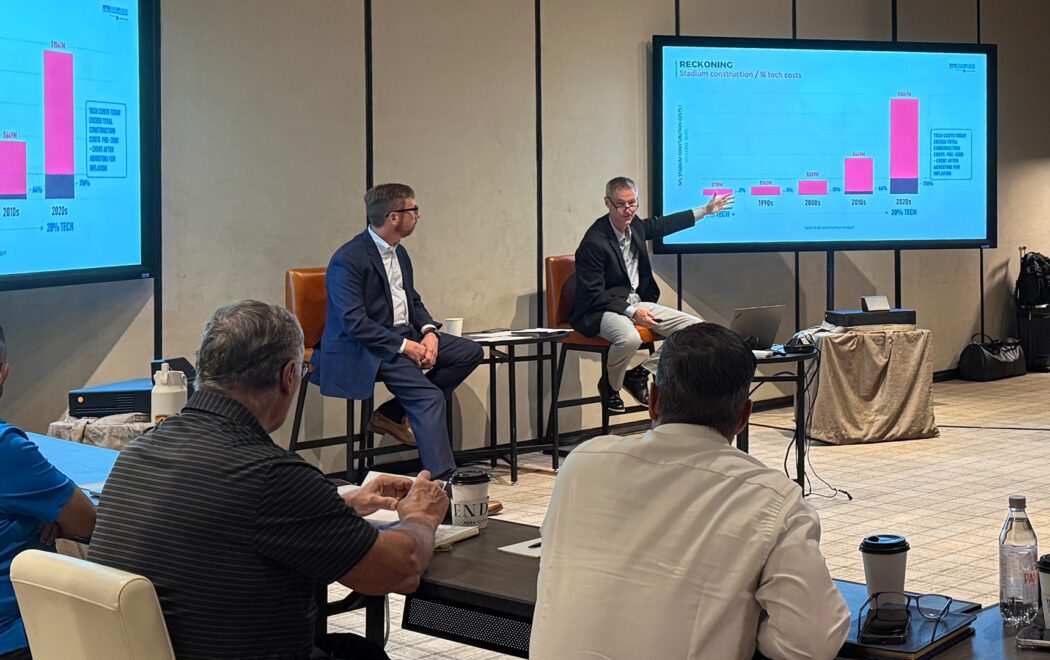
The math often makes team owners uncomfortable. Technology has grown from a rounding error in stadium construction budgets to roughly 20% of a new building’s cost, and venue designers expect that share to keep climbing. Venue revenue, meanwhile, grows by about 5% a year. “Smart stadium” forecasts shown at the event put today’s spending in the $10 billion to $15 billion range, heading toward $80 billion, which is wonderful news if you sell the gear and terrifying if you sign the purchase order.
The Wi-Fi versus DAS debate is the wrong argument
At the event, I raised something I have been hearing for the past couple of years. Many stadium IT leaders have told me they aren’t eager to put fans on Wi-Fi because their DAS is good enough, and I have speed tests showing how uneven stadium Wi-Fi has become.
AmpThink president Bill Anderson, who spent his career selling Wi-Fi, called the discussion a moot point. The only parties who care whether the answer is Wi-Fi or cellular are the vendors selling Wi-Fi and the carriers who bought spectrum and need a return on their investment. The real question is economic: do I get connectivity for free because I am a tier-one franchise, or do I pay for it? Once you are paying, you choose the most cost-effective path to the outcome.
I still think venues underweight what they surrender when fans ride the carrier network because DAS does not provide the analytics or identity that Wi-Fi does. But “Wi-Fi or DAS” is a vendor’s question. “What is my total connectivity cost and what do I get back?” is an owner’s question.
Convergence is settled technology and an unsettled procurement problem
Six years ago, a single converged network in a stadium was a radical idea. Today it is close to standard practice, and the proof points are there. One venue finally collapsed five isolated networks into one, reducing its switch count from more than 500 to about 300 and removing roughly $2.4 million in hardware costs from the budget before anyone touched the experience.
The obstacle is not technical. Anderson highlighted that US construction is the only major industry with declining productivity since the 1960s and that large construction is fundamentally a risk-mitigation business. A stadium is specified across 47 divisional buckets, each owned by a party with its own scope, liquidated damages clause, and financial interest in keeping that bucket intact. Convergence takes money out of someone’s pocket in nearly every case. That is why one project deleted the public manholes at its property line so the venue, not the carriers, would own entry rights, and why another development that handed the whole scope to one provider now pays two to three times the going rate for network services.
The ROI story is operating cost, not “fan experience”
One of the more interesting contrarian points was Anderson’s rule that anyone who says “fan experience” is off the team. Not because experience does not matter, but because it is the easy button vendors press, so nobody looks behind the curtain at the cost.
The alternative came from a recent stadium build in the Midwest, where ownership let one group deliver the entire technology stack under integrated project delivery, taking roughly 4% off the actual construction cost. They eliminated the video production control room, saving about $1.5 million, and rent a truck for roughly $20,000, including crew, when a big event needs one. A TV crew plugged in laptops and lit the main board in about an hour. The NCAA ran a championship on a PC staffed by college students. Concessions lead turns the building on from a tablet.
Those new revenue sources are the real prize. If opening a big venue costs seven figures in labor, small and mid-size events never pencil out, and a building that could host 200 events a year hosts only 55. Anderson sketched the same event dollar, with contribution rising from roughly 20 cents to 45 cents as activation costs fall. Increased stadium usage is the next frontier.
AI is the forcing function for convergence and an unpriced budget risk
Every venue leader in the room is using AI. One participating CTO described going all in, with an internal “AI champions” structure and a voice-agent deal for inbound support priced per resolved call. Others described multilingual chatbots handling work for staff who spent 40% of their day on routine email, and computer vision for exception-based screening rather than funneling every fan through a checkpoint. The design conversation has moved beyond the network: one new-build team is co-locating compute and a GPU alongside it so safety, security, and inference workloads run locally, because hauling that video to the cloud is too slow and too expensive.
This is where the convergence thesis aligns with “where the puck is going.” If you run separate campus, Wi-Fi, and data center networks, agents cannot see or act across them, and best-of-breed becomes a governance problem rather than a performance issue. AI is the tipping point that makes a single network the only sensible design.
What stadium IT leaders should do
- Present a portfolio view of technology capital, not a stack of system quotes, and model the five- and ten-year refreshes alongside the initial buy. The second check is what surprises owners.
- Get in the room before the divisional specifications are finalized. Once 47 buckets have 47 owners, convergence becomes a fight rather than a design choice.
- Own your entry points, conduit, fiber, and rooftop rights. Free infrastructure from a carrier is usually the most expensive deal in the building.
- Underwrite labor and activation savings and track them. “It improves the fan experience” will not survive an ownership group asking for net operating profit.
- Standardize the stack for commercial leverage but plan your exit. Antenna strategies differ enough across Cisco, Extreme, and HPE that a mid-life vendor change carries construction consequences.
- Budget for adoption, not just deployment. Stadiums are full of excellent technology that nobody uses, and adoption of new fan-facing tech often stalls at around 30%. Incentives to drive usage are a marketing line item, so fund them as one.
- Contribute to benchmarking. Per-cap numbers are defined differently by every team and are often sourced from vendors with something to sell. The normalized, market-adjusted index proposed with Syracuse University researchers only works if teams input real data.
Final Thoughts
The miracle makes a great movie. The system is what keeps a building winning for 30 years. Converge was a candid and refreshing discussion of that difference, and it took place among the people who sign off on the technology.
One of the more interesting aspects of the event was that none of the hard problems discussed were technical. Convergence works. The networks perform. AI is already in production at the venues in the room. What is broken is the economics surrounding the technology: a procurement model that carves a building into 47 buckets, a refresh cycle that nobody has figured out how to fund, an ROI narrative built on “fan experience” rather than operating profit, and benchmarking data that is too often supplied by vendors with something to sell.
In the movie Miracle, the Soviet program did not dominate because of a single player or a single game. It dominated because the system produced results year after year, regardless of who was on the ice. Stadium owners should hold their technology investments to the same standard. The upset is fun to watch. The dynasty is what pays for the building.